
Reenactment depicts Revolutionary War hardships
Trending
Some time ago I did an article on the things I miss from my early life. There are times when I look at what is going on around me and I think, "give me something good, or fun, or positive." Give me back those early days. After listening to the political pundits from previous elections, and now midterms, it is obvious they never end. Depending on the scenario, one could just record them and hit replay. So this month it is going to be a look back to another time, when things were not what they are today. A time when things were slower, and in my opinion, easier, that is until we look back historically.
With my reenacting years which started just before America's Bicentennial, it rapidly seemed like I was quickly jumping from one century to another just about every weekend. Then there were longer reenactment outings and events where more time was spent in the 18th century time period. As an example, a three-night weekend in 'Penns Woods' in the middle of the winter. A makeshift shelter, somewhat teepee style, with wooden branches packed in a circular shape with leaves packed in the open spaces, an oilcloth covering the outside to hopefully keep out the elements, rain or snow in this instance. The front was left open which seemed counterproductive. However, a nice fire was built with wood collected at an earlier time and stacked in that opening. The fire, nicely reflected by the shelter and oilcloth, was surrounded by rocks over which a tripod would be hung with a hook for a cast-iron cooking pot. There really was no choice about what dinner was going to be. The pot was filled half to three quarters with water into which potatoes, onions, meat (most likely venison or some other game), carrots, celery and whatever else we each brought with us and contributed. All went into the pot, a pot that would simmer for the full time we were there, any who showed up the following day would just add to it. It was the making of a great weekend. These types of encampments were mostly at either shooting events or in the middle of hunting season which increased the chances of additional meat.
It was always fun to see who would show up to the open invitation. One friend drove into the encampment on a particularly wintery night, driving several hours in a snowstorm, not going to a family event on the other side of his town, because those hosting it and invited felt the weather was too bad to travel. A lot of hootin' and guffaw's took place at that time thinking about that as we sat in the woods in the middle of a snowstorm in the middle of Penns Woods. Most interestingly, he didn't arrive until 10 p.m. He was treated to a hot meal that was on that fire all day. He then added his fresh, raw vegetables and meat that would continue to cook over the fire for the next meal. It took a fair amount of 18th century equipment carried onto the site. It was a recreation of what we suspected happened many times in the 18th century.
At this point I'll relate a conversation I had with another reenactor at a different event as we were packing up to leave. He was an elderly person (probably younger than I am now) and was getting winded as were all reenactors loading up to return home from an event in Maryland. Our vehicles were side by side. His was a nice new Chevrolet pickup. At one point we all stopped for a few minutes from tearing down and loading our gear by taking a well-deserved break. I commented on his new pickup which he bought primarily to do these types of events. He sat on the tailgate and said, and I paraphrase here, "Yeah, I bought this new pickup to carry my gear: tent, poles, pins, stakes, three-pound hammer, ground cloth, blankets, a cooler of food, kettles, pots, beverages and what seems like 20 pounds worth of clothing, musket, cartridge box and the rest of my gear, all to portray a man who had nothing. Needless to say, we all had a good laugh over that because that is what we all did. Today, I relish looking back at those times and events.
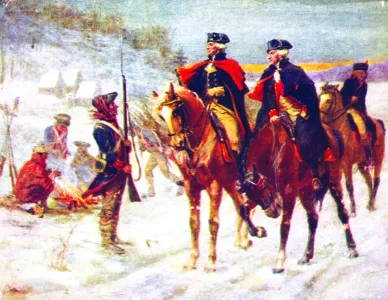
But in doing this and other events, I never forgot how difficult those actual soldiers in fighting the Revolutionary War had it. Everything for the most part had to be carried. Horses and wagons were used to move food when available, ammunition and the wounded. The weight of a soldier's needed gear would sometimes top off at a carry weight of 35 pounds, not including the kettles that a unit would share to cook in.
In reading "A Narrative of a Revolutionary Soldier, Some of the Adventures, Dangers, and Sufferings of Joseph Plumb Martin", we weren't that far off in his statement of equipment weight: It is repeated throughout the Narrative the many times the men would leave their cast iron pots alongside the road because they had nothing to put in them anyway. Here is an excerpt from Joseph Plumb Martin's Narrative (ed. This was at Gulph Mills, PA, 1777) :
"While we lay here there was a Continental thanksgiving ordered by Congress; and as the army had all the cause in the world to be particularly thankful, if not being well off, as least, that it was no worse, we were ordered to participate in it. We had nothing to eat for two or three days previous, except what the trees of the fields and forests afforded us. But we must now have what Congress said - a sumptuous thanksgiving to close the year of high living, we had now nearly seen brought to a close."
He goes on to write: "Well - to add something extraordinary to our present stock of provisions, our country, ever mindful of its suffering army opened her sympathizing heart so wide, upon this occasion, as to give us something to make the world stare. And what do you think it was, reader?--Guess–You cannot guess, be you as much of a Yankee as you will. I will tell you: it gave each and every man half a gill of rice (1/4 cup), and a tablespoon full of vinegar!!! After we had made sure of this extraordinary superabundant donation, we were ordered out to attend a meeting, and hear a sermon delivered upon the happy occasion." At Gulph Mills, PA.1777 [1]
And as we think, "what a terrible Thanksgiving meal", these soldiers were not happy with that ration, even though it probably was a Thanksgiving meal for them. In his diary, he also states just before this day: "I lay here two nights and one day, and had not a morsel of any thing to eat all the time, save half of a small pumpkin, which I cooked by placing it upon a rock the skin side uppermost, and making a fire upon it; by the time it was heat through I devoured it with as keen an appetite as I should a pie made of it at some other time."[2]
Given what they have had to eat and the strength that would be zapped from marching, setting up camp and going into battle, leaving a kettle alongside the road would probably be more of a benefit to them health wise than carrying it to no use. The journal is very interesting and gives the average soldier’s assessment of daily life in the Revolutionary War.
My experiences in the woods in no way match what this soldier had to do in real life. At the end of our pleasant adventure, we packed it all in, got into our warm vehicles after much laughter and goodbyes, and headed home to cleaning and washing up gear and stowing it away for the next experience, a hot shower and a warm meal and comfortable bed. He would not have that advantage.
We truly owe a debt to those who fought and still fight for this Country. Joseph Plumb Martin didn't even know if he would have a country but believed in the mission to create it and risked all. I salute him and all our patriots. May their sacrifices that created our Country, and those of today, continue to serve us well.
Born Nov. 21, 1760, Martin died May 2, 1850, in Prospect, Maine at age 89. His gravestone, to summarize his varied experience, simply cited: A Soldier of the Revolution.[3]
Footnotes
Joseph Plumb Martin, A Narrative of a Revolutionary Soldier (Previously Published as Private Yankee Doodle). Signet Classic, Penguin Group, New York. 2001. P87.
Ibid. P. 91
https://www.nps.gov/people/joseph-plumb-martin.htm accessed 9/10/26