
Federal mirrors represent early American furniture
Trending
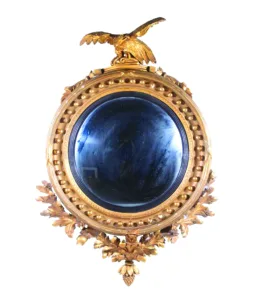
What could be more representative of early American furniture than a Federal mirror? While the term can describe several types of mirrors, including large rectangular mirrors in scrolled wooden, usually mahogany, frames, or a style with a decorated upper panel and often columns on the sides of the frame, the quintessential Federal mirror is round, convex, and housed in a giltwood frame with a spread-winged eagle perched on top. These mirrors are also called “bull’s-eye,” due to their round shape.
In the Federal period of American history, that is, the late 18th to early 19th centuries, these round mirrors had a practical value. The convex shape helped reflect as much light as possible, which was important in the days before electric lighting. Some styles have candle sconces, called girandoles, attached to the frame for additional illumination.
Of course, these mirrors weren’t just practical. The gilded frame and majestic eagle provide an air of grandeur. Today’s collectors may see the eagle as uniquely American, especially on Federal furniture, but its significance predates that. In fact, some Federal mirrors were made before the adoption of the eagle as an American symbol. Similar styles were made in Europe, and, although many were sold to Americans, today’s dealers and auction houses often describe them as “Classical,” “Neoclassical,” or, if made in England, “Regency” rather than “Federal.”
Both American and European furniture in this time period drew influence from the art and philosophy of ancient Greece and Rome. The eagle was an important symbol then, associated with the Greek Zeus or Roman Jupiter, the king of the gods. Many Federal mirrors have additional Classical imagery. One that sold for $1,125 at Thomaston Place Auction Galleries has a garland of oak leaves, another symbol of Zeus, in addition to its eagle crest.
* * *
Q: How can I find the value of a collection of comic books? There are Action Comics, Walt Disney, and more. They are very old and have tears in the corners.
A: Unfortunately, the torn corners mean that your comics are probably not worth very much, unless they are exceptionally rare titles. Condition is extremely important when it comes to comic books. Serious collectors have theirs graded. This is expensive, and usually not recommended unless you are certain the comics have high value.
Sources like CGC Comics (cgccomics.com) and Heritage Auctions (ha.com) offer online guides to grading standards that cover factors such as wear and tear, paper color, and ink brightness. “The Overstreet Comic Book Price Guide” by Robert Overstreet is considered the definitive guide to comic book values and lists nearly every title and issue. Look for a copy at your library.
You may also want to look up auction houses that deal in comic books. Some of them provide free appraisals or have online resources to help you value yours.
* * *
Q: Can you help me find out more about an unusual pair of china dishes? They are shaped like leaves, plain white, with a small hole for a handle at one end. There is a mark at the bottom of each one that reads “China / Lillian Vernon / 87” in blue print. Do you know what they might be worth?
A: Lillian Vernon (1927-2015) was born in Germany, and her family emigrated to New York in 1937 to escape the Nazis. She started her eponymous giftware company in 1951, placing advertisements in women’s magazines for personalized goods.
The business grew quickly, and she released her first catalog in 1960. Products expanded to include ceramics, glassware, textiles, holiday decorations, toys, and more, and the company partnered with well-known manufacturers like Madame Alexander, Gobel, and Avon. Vernon is considered a pioneer among American women entrepreneurs, and many of her possessions, including the kitchen table where she started her business, are in the Smithsonian’s collection.
The Lillian Vernon catalog is still in business. The marks on your dishes probably indicate where they were made (China) and the date (1987). Lillian Vernon dishes from this period usually sell for about $10 to $20 each.
* * *
TIP: Ordinary beer is great for cleaning a gilded mirror frame. Just pour it on a soft rag, rub gently, and dry.
* * *
Kovels answers readers’ questions sent to the column. Send a letter with one question describing the size, material (glass, pottery) and what you know about the item. Include only two pictures: the object and a close-up of any marks or damage. Be sure your name and return address are included. By sending a question, you give full permission for use in any Kovel product. Names, addresses or email addresses will not be published. We do not guarantee the return of photographs, but if a stamped envelope is included, we will try. Questions that are answered will appear in Kovels Publications. Write to Kovels, (Name of this newspaper), King Features Syndicate, 300 W. 57th Street, 41st Floor, New York, NY 10019, or email us at collectorsgallery@kovels.com.
* * *
CURRENT PRICES
Current prices are recorded from antiques shows, flea markets, sales and auctions throughout the United States. Prices vary in different locations because of local economic conditions.
Pottery, midcentury, vase, vertical ruffled panels, pink and blue, flared neck, fluted rim, round base, marked, Hedi Schoop, Hollywood, 1940s, 7 inches, $30.
Firefighting, helmet, yellow, shield on front, Engineer 1, plastic, marked, Cairns & Bro., 8 x 12 x 18 inches, $135.
Candy container, Liberty Bell, glass, metal cap, relief Liberty on base, U.S. Centennial, 1876, 3 inches, $200.
Furniture, table, sewing, American Empire, flame mahogany, two drawers, opalescent glass pulls, pendants at corners, carved baluster stand, four paw feet, c. 1840, 30 x 21 inches, $250.
Rug, Navajo, center serrated diamond, red, yellow, brown trim, light brown field, dark brown outer border, red inner border, c. 1930, 84 x 52 inches, $455.
Porcelain-Chinese, cup, tea, multicolor enamel, figure riding mythical animal, allover engraved ground, flared lip, short foot, c. 1800, 2 3/4 inches, $705.
Textile, flag, American, 40 stars, parade, printed, cotton muslin, wood dowel staff, 1899, flag 12 x 17 inches, staff 27 inches, $830.
Advertising, sign, Lee jeans, round, cowboy on horse, Authentic Western Pants and Jackets, Wear Lee Riders, brown ground, two-sided, tin, Stout Industries, 1960s, 18 inches, $890.
Stone, argillite, totem pole, carved, square base, signed, Glen Pollard, Haida, 15 inches, $1,025.
Furniture, stand, valet, Jacques Adnet, metal frame, light brown leather wrapping, rectangular tray top, three hangers, shoe rack on base, France, 42 1/2 inches, $1,920.
* * *
Register on Kovels.com to access subscriber content for FREE! Learn from our expert answers to readers’ questions about marks, values, and identification. Find auction houses, collectors’ clubs, museums, repair services, and more in our Business Directory. Discuss antiques and collectibles with other collectors on our forums. Find events on our Event Calendar. Stay up-to-date with our latest news and blog. And sign up on Kovels.com to receive Kovels Komments, our free weekly email full of information about antiques and collectibles. Look for it every Wednesday.