
Trending
I have overheard the following conversation all too many times:
Person 1: "How do you find the time to read so much?"
Person 2: "Well, I listen to audiobooks in the car and at the gym and..."
Person 1: "Oh, so you’re not really reading. Audiobooks are cheating."
Well, have we got news for those like Person 1: audiobooks are not cheating.
First of all, why is it seen as “cheating?” Is reading hard work that we are somehow skipping? I sure hope not. If reading is supposed to be work, then I have been doing it wrong for years.
The basics
Let’s set aside the part of the equation that beginning readers (up to about fifth grade) need to read and process what they’re reading by decoding words and understanding their meaning. As adults (and also as teens), we don’t need to practice decoding; we read for comprehension and enjoyment. As such, what does it matter how the information enters our brain? What I usually ask people, if questioned about this topic, is: can you understand what you have heard? Do you need practice reading? No? Do you enjoy the stories? Yes? Can you talk about it later? Okay then. They have successfully internalized a story. We must also consider those who can’t read print. Are books in Braille truly “reading?” Can a person with vision issues say they are an avid reader when their books are audible? I would argue that, yes, they can.
The science
If you look at this from a perspective of science, the brain processes a story that is read in pretty much the same way as a story that is heard. University of Virginia Psychologist Daniel Willingham, author of "Raising Kids Who Read: What Parents and Teachers Can Do," explains that, “for typical adults (who decode fluently) listening comprehension and reading comprehension [are] mostly the same thing. And experiments show very high correlations of scores on listening and reading comprehension tests in adults.” So… yes, it’s pretty much the same thing. Dr. Willingham also objects to the often-chosen word, “cheating,” with regard to reading. ”Comparing audiobooks to cheating is like meeting a friend at Disneyland and saying, ‘You took a bus here? I drove myself, you big cheater.’ The point is getting to and enjoying the destination. The point is not how you traveled.”
In an interview with CNN, Willingham also asks us to consider how the author wanted their work to be experienced. Books such as Amy Poehler’s "Yes, Please" are almost meant to be heard, and the narrator’s inflections (Poehler herself) add an extra element to the experience. Some titles, such as dense nonfiction, may be far more enjoyable to the reader than the listener, as they can easily flip back to reference previous passages.
Of course, this leads us to the question of the drama: Is it cheating to read Shakespeare, when it was meant to be seen?
Book of the week!
If you are going to read one book, give this one a try...
Big Little Truths (sequel to Big Little Lies) by Liane Moriarty
(New adult fiction: family life, thriller) 464 pages.
In a nutshell: Ten years later, the friends from Big Little Lies (2014) have new headaches, traumas and secrets.
Moriarty has reclaimed her girl group after their HBO-funded joyride in Monterey, California, with a sequel that returns them to Australia's (apparently just as beachy and bougie, though fictional) Pirriwee Peninsula. She writes this in a brief author's note that also suggests the new book can be read independently of either the first or the series, which is not wrong, but it certainly helps to come in with a clear mental directory of this large cast and their complicated relationships, and if you remember which actor played whom, so much the better.
As the novel opens, a bizarre incident occurs in the principal's office at the local high school: A severed finger arrives in the mail. The day this occurs becomes known as D-Day, and vignettes from it appear at intervals throughout the book, along with snippets of dialogue from transcripts of "safe space" counseling sessions held in its aftermath for the students, now 15 and 16 and causing their parents' typical teen trouble.
Also in play: Madeline's 50th birthday party, complicated by the fact that she's found a lump in her breast and her husband, Ed, has been behaving strangely. Her bestie, Celeste, is still dealing with the fallout from her evil husband Perry's death in the first book, including an awkward relationship with his mother, Mary-Louise, and her twins having learned unpleasant truths about their late father. All the kids are crazy about their brilliant new history teacher, Melody Montclair, who assigns them a project on misunderstood historical figures that brings Winston Churchill into the mix. Melody is also charming the mothers, whom she's gotten to know by joining their Beach Boot Camp.
There's no shortage of plot, but Moriarty's real gift is for witty dialogue and relatable characters. Once you get them straight, you'll follow them anywhere…and there are indeed seeds for another sequel.
Interested in watching the show? We have seasons 1 and 2 on DVD, each of which you can borrow for three weeks for 50¢. What a deal.
Bottom line: Don't wait for the TV series. Moriarty's sparkling writing is worth the read.
•••
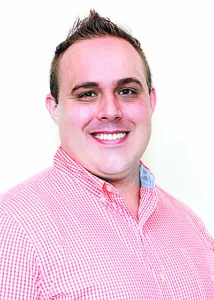
Vince Giordano has been the librarian and director of the Juniata County Library since April 2015.